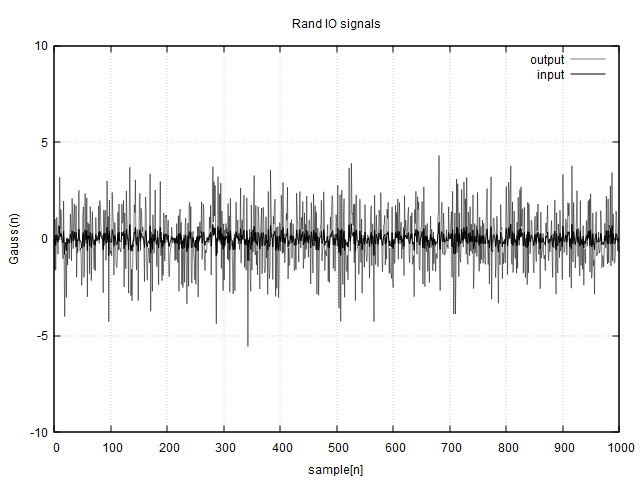
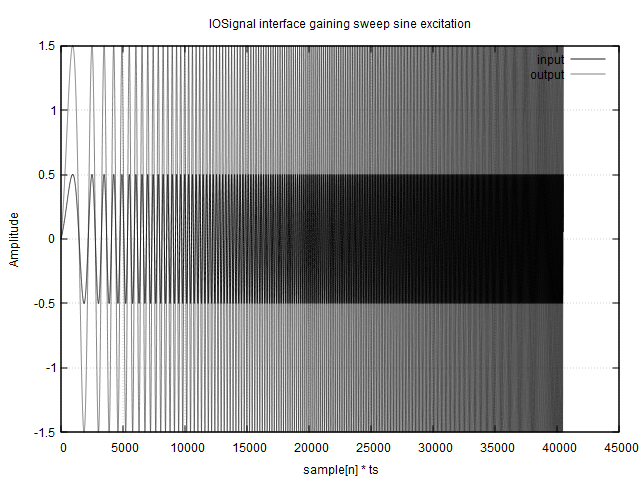
- This is how three of those classes work together (clumsy, but it works !)
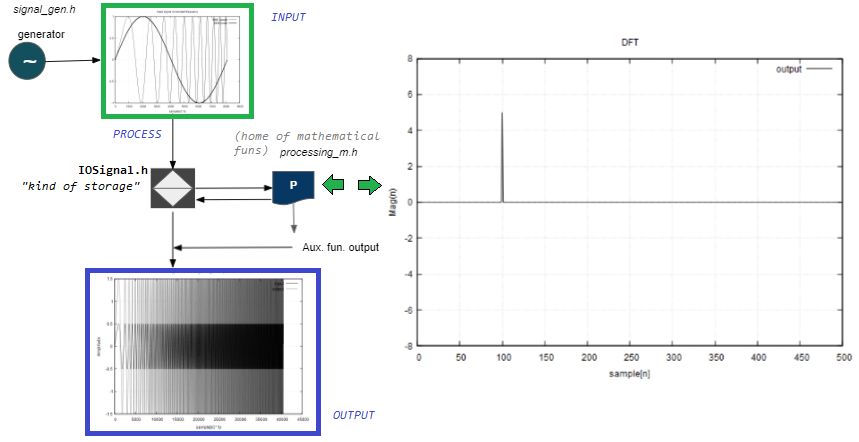
- Here is connection between IOSignal.h and processing_m.h
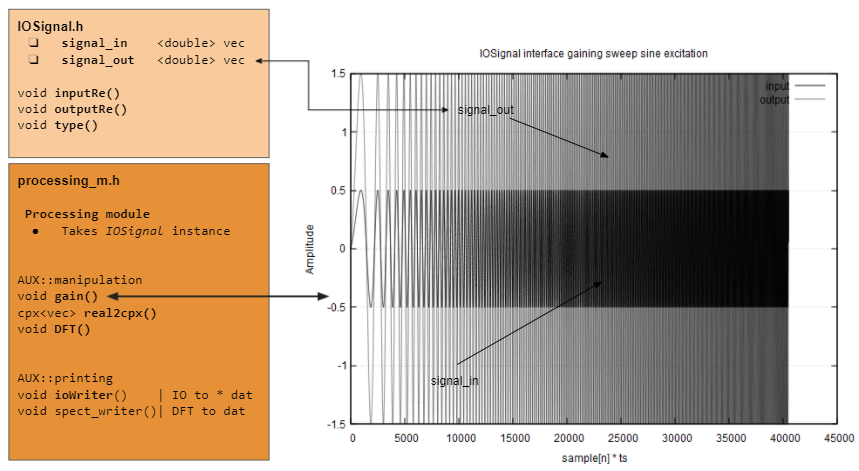
Main Idea is to store the input and output within the same class, some sort of "numeric storage"
        #pragma once
        #include < tiostream >
        #include < vector >
        #include < complex >
        using namespace std;


          /*
            Global type signal interface ::: IOSignal.h      *

            input |   signal_in  |
            ----> |    |_   _|   | ------ >  || PROCESS ||
                  |      | |     |                      |
                  |      | |     |                      |
                  |     _| |_                           |
                  |    |_____|    N T E R F A CE <------|  return
                  |  signal_out  |

          */
          struct IOSignal{

            //  domain for input/ output signal manipulation

             // sampling frequency
             double fs;

             // for time domain
              vector signal_in;
              vector signal_out;

              // for frequency domain
              vector> spectrum_in;
              vector> spectrum_out;

              void inputRe(const vector& sIn) {

                  this->signal_in = sIn;

               };

               void outputRe(const vector& sOut)
               {
                   this ->signal_out = sOut;
               }

               void type(){

                vector ::iterator pos;
                cout << "\n INPUT signal :" ;
                  for ( pos = signal_in.begin(); pos != signal_in.end(); pos++)
                    {
                        cout << *(pos) << " ";

                    }
                    cout << endl;

                  cout << "\n OUTPUT signal :" ;
                  for ( pos = signal_out.begin(); pos != signal_out.end(); pos++)
                    {
                        cout << *(pos) << " ";
                    }
                    cout << endl;
         };

    };
      #pragma once
      #include < sstream >
      #include < cmath   >
      #include < complex >
      #include < vector  >
      #include < iostream >
      #include < fstream >

      const double PI = 3.14159265358979323846;

      /*
            ___         |
          /\  \        |   IOSignal
          /::\  \       |       |              |
        /:/\:\__\      |      |||   |   |    |||
        /:/ /:/  /      |.. |||||||||||||||||||||||||.... -> || PROCESSING ||  --> output to IOsignal
      /:/_/:/  /              ||| | ||  ||||   | ||
      \:\/:/  /                |  |  |   ||       |
        \::/__/                       |
        \:\  \
          \:\__\
          \/__/  PROCESSING MODULE
                  Global functions for auxilliary use
      */

          // DSP General module for processing signal interface IOSignal

          // GAIN THE SIGNAL :::
          // time domain function

          void gain( IOSignal& iosig, double fact)
          {
              // Input Vector
              vector inVec = iosig.signal_in;

              // Output Vector
              vector outVec;
              vector:: iterator p; // pointer u vektor inVec
                  for ( p  = inVec.begin(); p!= inVec.end(); p++)
                  {
                      double value = *(p);
                      iosig.signal_out.push_back(value*fact);
                  }
          }

          // turn real double values to complex double values for DFT
          vector> real2cpx( IOSignal& iosig)
          {
            vector> cpx;
                if(iosig.signal_in.empty())
                {
                  cout << "this signal is empty \n";
                  cpx ={0,0};

                }
                else{

                    vector x = iosig.signal_in;
                        int N = x.size();

                        for (size_t i = 0; i < N; i++)
                        {
                            cpx.push_back( {x[i], 0});
                        }
                    }
            return cpx; // retunr complex vector
          }

            // compute DFT from signal interface and return it to freq_dom cpx vector
            void DFT( IOSignal& iosig)
            {

              //DFT ::: inputs
                  // input vector
                  vector x = iosig.signal_in;
                  //int N = x.size();                         //| GRESKA.. NE IDE DO VELICINE X.SIZE() NEGO DO FS !

                  int N = iosig.fs;

                  std::complex intSum;                   //| take memory for computation
                  iosig.spectrum_in.reserve(N);                  //| write to freq. domain N
                  vector> X = real2cpx(iosig);   //| turn real signal to complex for DFT

                // loop through each k of DFT
                    for (int k = 0; k < N; k++)
                    {
                        intSum = complex(0,0);
                        for (int n = 0; n < N; n++)
                        {
                            double realPart = cos( ((2*PI)/N)*k*n);
                            double imagPart = sin( ((2*PI)/N)*k*n);
                            std::complex w(realPart, -imagPart);
                            intSum += X[n]*w;
                        }
                      iosig.spectrum_in.push_back(intSum);
                    }

                // transformation length
                int L  = floor(iosig.spectrum_in.size()/2);
                double mag;
                  for (size_t i = 0; i < L ; i++)
                  {
                    //   |a| = ( a^2 + b^2)^0.5
                    mag = sqrt(pow(iosig.spectrum_in[i].real() ,2) + pow(iosig.spectrum_in[i].imag(),2));
                    iosig.spectrum_out.push_back( 2*mag/(2*L));
                  }
            }
      /*   ___      _       _   _
          / _ \_ __(_)_ __ | |_(_)_ __   __ _
         / /_)/ '__| | '_ \| __| | '_ \ / _` |
        / ___/| |  | | | | | |_| | | | | (_| |
        \/    |_|  |_|_| |_|\__|_|_| |_|\__, |  FUNCTIONS
                                        |___/
      */


      // write interface to file
      void ioWriter( IOSignal& interface, string fileName)
        {
          ofstream os(fileName);
                  // if interface vectors not equal, give some warning
                  if(interface.signal_in.size() != interface.signal_out.size())
                  {
                      cout << "Vectors in IOSignal unequal... \n";
                      cout << "signal_in.size() taken for the end raw in the file ... \n";
                  }

          // print both signals to interface/ signal_in size ...
          for (int i = 0; i < interface.signal_in.size(); i++)
          {
            os << i << "\t"< cpx_dft; // complex DFT output
        double abs_val;          // place holder absolute value

        ofstream os(fileName);   // open file to stream data in

        cout << iosig.spectrum_out.size();

        for (size_t i = 0; i < iosig.spectrum_out.size() ; i++)
        {
          cpx_dft = iosig.spectrum_out[i];                                 // take single cpx value
          abs_val = sqrt(pow(cpx_dft.real(),2)  + pow(cpx_dft.imag(),2));   // calcuate magnitude of complex no.
          os << i << "\t" << abs_val << endl;
        }
          os.close(); // close the file
          cout <<" magnitude of DFT to *.dat exported " << endl; // say when finished
      }
        #include < iostream >
        #include < vector >

        using namespace std;


        #include "signal_gen.h"
        #include "IOSignal.h"
        #include "processing_m.h"


              //*****************************************************************|
              //
              //       || signal input ||
              //       ||              ||      vector      processing_m.h
              //       ||  INTERFACE ---------------------------->|| DSP ||
              //       ||              ||                             |
              //       ||signal output<-------------------------------|
              //
              //
              //*****************************************************************|


              int main()
              {

                  // INPUT
                  //

                  signal_gen sineSweep;


                  // fs= 8096;
                  // f0 =  1
                  // f1 = 10
                  // Amp = 5
                  // PhaseShift = 0
                  // max time = 1;


                  // Interfaces
                  //


                      // CH1:::

                      signal_gen myWave;
                      myWave.sine(8096,10,5,0,1);

                      IOSignal channel_01;
                      channel_01.signal_in = myWave.getSignal();
                      ioWriter(channel_01,"DFT_mag.dat");


                      // CH2:::
                      IOSignal channel02;
                      vector k = sineSweep.getSignal();
                      channel02.signal_in = k;

                      // CH3:::
                      IOSignal channel03;
                      channel03.inputRe(sineSweep.getSignal());


                      // gain channel03 x 2
                         gain(channel03, 2);
                         ioWriter(channel03,"ioFile.dat");


                  // random channel
                      signal_gen gaussian;                       // inicijaliziraj
                      gaussian.random_normal(0,0.3, 1000);       // generiraj
                      IOSignal channel04;                        // stvori interface
                      channel04.inputRe(gaussian.getSignal());   // kopiraj generator u interface
                      gain(channel04,5);                         // obradi kanal u interfejsu i stavi u output vector
                      ioWriter(channel04,"io_random.dat");


                  cout << endl <<"... end of main"<
        set title "DFT"
        set xlabel 'Frequency (Hz) '
        set ylabel 'Mag(n)'
        set yrange [-8:8]
        set xrange [0:50]
        set grid
        plot 'DFT_mag.dat' using 2:3 with line lt -1 lw 1 title 'output'
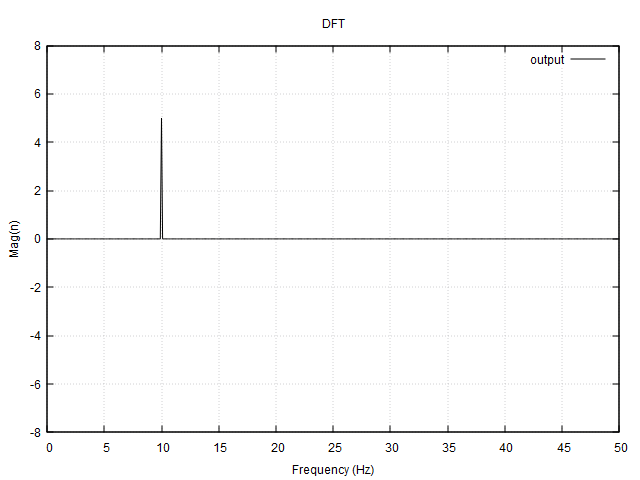
Lessons learned...
with: "procssing_m.h" and "IOSignal.h" can gain the signal before computing dft .. here two examples