"sdof_digital.h"
Explanation *ISO 18431-4 Standard
#ifndef SDOF_DIGITAL_H
#define SDOF_DIGITAL_H
#include &l tiostream >
#include &l cmath >
#include &l string >
#include &l sstream >
//using namespace std;
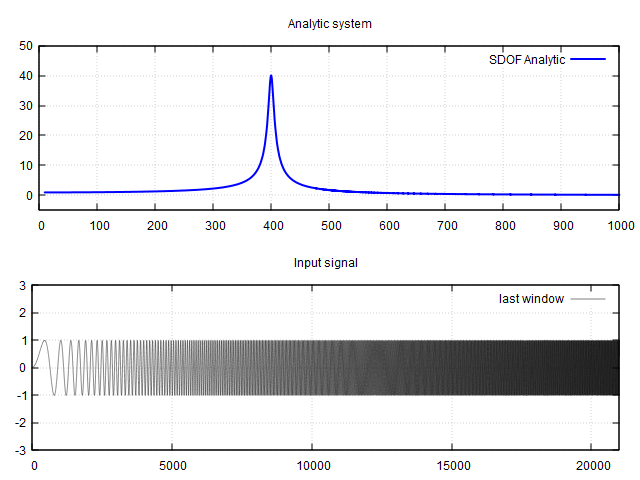
/* DIGITAL H(w) = FRF(f) ===== > to H(z)
_____ _____ ____ ______ * . Q = 1/2D
/ ____| __ \ / __ \| ____| | / \
| (___ | | | | | | | |__ |..../ | \
\___ \| | | | | | | __| | fr \............... [N]
____) | |__| | |__| | | |------------------------->
|_____/|_____/ \____/|_| | |
fmin fmax
DIGITAL SYSTEM ::: sdof_digital.h
// Difference equation for computation of extreme response spectrum
// Explanation *ISO 18431-4 Standard
Response of a linear Single Degree of Freedom System (SDOF system) to vibration,
according to its natural frequency, for a given damping ratio. The response is
described here by the relative movement of the mass of this system in relation
to its support.
//x2 = β0 x1 k + β1 x1(k −1)+ β2 x1(k − 2) − α1x2(k −1) − α2 x2(k − 2)
// RECALCULATING SDOF filter coefficients
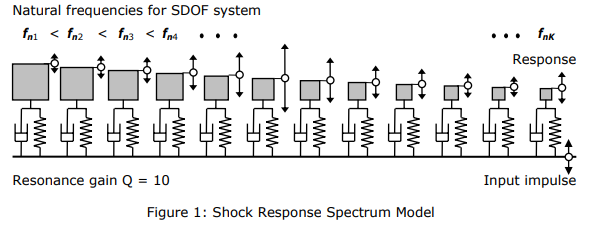
/* Shock
Response Spectrum is defined as the response to a given acceleration
acting at a set of mass-damper-spring oscillators
wnS / Q + wn^2
A2/A1 = ______________________ --> transformed to Z domain ....
s^2 + (wn/Q)S +1
                     b0 + b1*z^-1 + b2*z^-2
             H(z) =  _________________________
                      1 + a1*z^-1 + a2*z^-2
Jan Gusic, 7.5, 2021
*/
  /*   DIGITAL SYSTEM FORM ***************************************************************
  Sdof_digital is a calss for calculating coefficients, which are in turn returned to the
  member structure C ( coefficients) ... this structure holds the difference equation coeffs.
  C --- | a1
        | a2
        | b0
        | b1
        | b2

 Now returning the structure to the public structure of 'deq' ( diff. equations interface)
 coefficients are taken by the internal function

 deq MyEquation;
 Sdof_digital SDOF;  which returns structure C after calling returnCoefficients()
 ( Ex. for first coefficients can be called SDOF.returnCoefficients().a1, .. )

 Now, put the SDOF to Diff equation for single value as...
 MyEquation.process(Sdof_digital::C& Coeff, 0 )

 And check the coefficients passed by reference from Sdof_digital instance as
 MyEquation.type()
 cout << SDOF.type();

 //they should be the same..
 FOR EACH signal value in signal_in

MyEquation.process(SDOF.returnCoefficients(), signal_in(i))

 END
*/
  class Sdof_digital
  {
  private:
              double PI = 3.14159265358979323846;                     //| pi
              double fs;                                              //| sampling f
              double fr;                                              //| resonance
              double Q;                                               //| Q
              double Ts;                                              //| samp. time
              double wn;                                              //| nat, freq.

              // BiQuad filter coefficients
              double A, B;
              double b0,b1,b2;
              double a1, a2;
  public:

              struct C{

                  double b0,b1,b2, a1, a2;
              };


      Sdof_digital(/* default == Bypass */);                         //| Bypass sinal
      Sdof_digital(double, double, double);                          //| Digital system initialization
      ~Sdof_digital();

      std::string type();                                            //| write coefficients to the screen
      C returnCoefficients();                                        //| function returns C structure after reading them ..

  };
  Sdof_digital::Sdof_digital()
  {   //bypass coefficients for xin = xout .. no processing
      // with this fitler * off
      b0 = 1;
      b1 = b2 = 0;
      a1 = a2 = 0;
  }

  std::string Sdof_digital::type()
  {
      std::stringstream sout;
      sout << "| fs:" << this->fs << "| fr:" << fr << "| Q: " << Q << "\n";
      sout << "| a0:" << this->a1 << "  | a1:" << this->a2 << "\n";
      sout << "| b0:" << this->b0 << "| b1:" << this->b1 << "| b2:"<< this->b2 <<"\n";

      return sout.str();
  }

  Sdof_digital::~Sdof_digital()
  {
  }

  Sdof_digital::Sdof_digital(double Fs, double fr, double Q)
  {                           //| sampling
                              //|          | frequency
                              //|                  |  Q
      this->fs = Fs;
      this->Ts = 1/fs;
      this->wn = 2*PI*fr;
      this->fr = fr;
      this->Q  = Q;

      this->A = wn*Ts/2/Q;
      this->B = wn*Ts*sqrt(1-1/4/Q/Q);

      this->b0 = 1-exp(-A)*sin(B)/B;
      this->b1 = 2*exp(-A)*(sin(B)/B-cos(B));
      this->b2 = exp((-2)*A)-exp(-A)*sin(B)/B;
      this->a1 = (-2)*exp((-1)*A)*cos(B);
      this->a2 = exp((-2)*A);

  }
  Sdof_digital::C Sdof_digital::returnCoefficients()
  {
      C coeff;

          coeff.b0 = this->b0;
          coeff.b1 = this->b1;
          coeff.b2 = this->b2;

          coeff.a1 = this->a1;
          coeff.a2 = this->a2;


      return coeff;
  }


  // Difference equation
  struct deq
  {
       // coefficients
      double b0, b1, b2;
      double a1,a2;

      //input history
      double x1,x2;

      //output history
      double y1, y2;

      // procesurianje ::: Biquad filter normalized
      double process(const Sdof_digital::C& COEFF,double x0){

          b0 = COEFF.b0;
          b1 = COEFF.b1;
          b2 = COEFF.b2;

          a1 = COEFF.a1;
          a2 = COEFF.a2;

          double y0 = b0*x0 + b1*x1 + b2*x2 - a1*y1 -a2*y2;

          x2 = x1;
          x1 = x0;
          y2 = y1;
          y1 = y0;
          return y0;
      }

      // type the filtering coefficients to the console ..
      void type()
      {
          std::cout << "\n\n Difference equation setup:::";
          std::cout <<"| bo:" << b0 << "| b1: " << b1 << "|b2: " << b2 << std::endl;
          std::cout <<"| a1:" << a1 << "| a2:" << a2 << "... " << std::endl;
      }
  };
  #endif
main.cpp
          #include "sdof_digital.h"
          #include "signal_gen.h"

          using namespace std;

          // Functionality of sdof_digital.h
          // herewith confrimed ..
          //
          //

          int main()
          {

              //(1)
              // Define Digital system :: Sdof_digital MySdof(fs,fr,Q)

              Sdof_digital sys1;
              Sdof_digital sys2(21000, 400, 40);
              cout << sys2.type();

          //(2)
            // Define Digital process :: deq CH_X; i.e. Turn the system to H(z) , get coefficients
            // then CH_X(const Sdof_digital::C&, signal_input )

              deq CH1;
              CH1.process(sys2.returnCoefficients(),1);
              CH1.type();
          //(3)
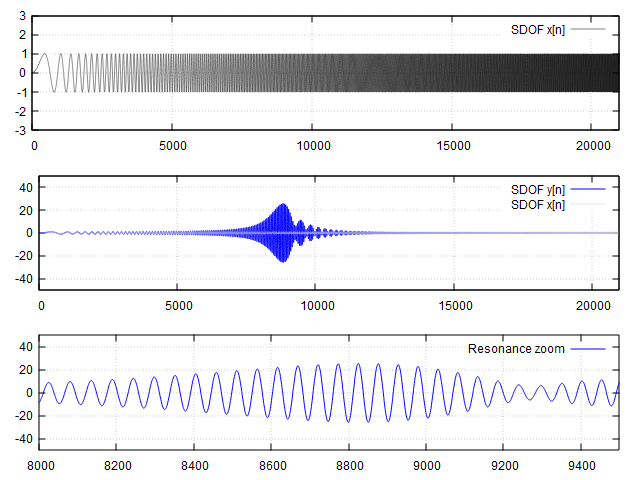
              // Define input signal from signal_gen.h

              signal_gen sineWave;
              sineWave.sweep_linear(21000,1, 1e3, 1, 0,1);
              vector <double> x = sineWave.getSignal();

          //(4)
              // define the output vector to receive processed series ...
              vector < double > y; double yy;

          //(5)
              // process the series
              // x2  = β0 x1 k + β1 x1(k −1)+ β2 x1(k − 2) − α1x2(k −1) − α2 x2(k − 2)

              for (size_t i = 0; i < x.size(); i++)
              {
                yy = CH1.process(sys2.returnCoefficients(), x[i]);
                y.push_back(yy);
              }

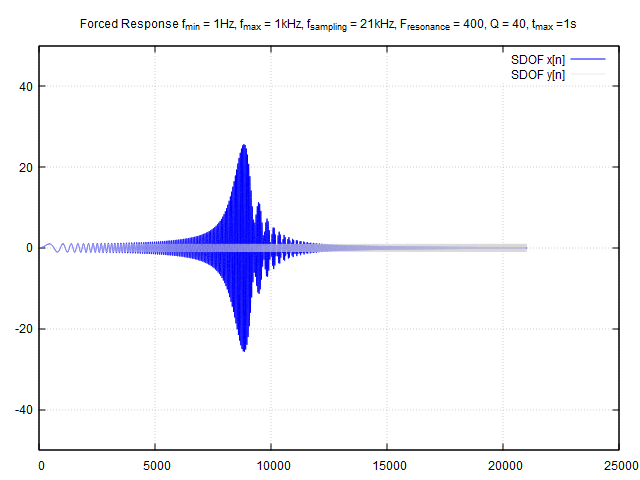
          //(6) write to file for Gnuplot..
              ofstream results("mySys_test.dat");
              for(size_t i = 0; i < y.size(); i++){
                  results << i << "\t" << x[i] << "\t" << y[i] <<endl; }

                  results.close(); return 0;

          }